Optimization Series: Mastering the Transfer Bonus Window
A limited-time transfer bonus can meaningfully change which program gives you the most miles for your points — but only if you have a redemption ready before you move anything.

Transfer bonuses are among the most time-sensitive opportunities in the points-and-miles world. They are easy to miss, and many travelers only discover them after the window has closed. But when a bonus aligns with a trip you are already planning, it can stretch your points balance considerably — without any additional spending.
This post covers how transfer bonuses work, why programs run them, and how to evaluate whether a current bonus is actually worth acting on for your specific situation.
What is a transfer bonus?
When you move points from a bank loyalty program — Chase Ultimate Rewards, Amex Membership Rewards, and others — to an airline or hotel program, the standard exchange is 1:1. Transfer 10,000 Chase points to United MileagePlus and you receive 10,000 United miles.
During a transfer bonus, the receiving program deposits extra miles on top. A 20% bonus from Chase to Air Canada Aeroplan, for example, means that 10,000 Chase points become 12,000 Aeroplan miles instead of the usual 10,000.
One detail worth understanding: the bonus applies to the miles received, not the points sent. You still transfer the same number of points from your bank account — the partner program simply credits you more on the other end. Think of it as a bonus deposited on arrival, not a discount on the departure.
Why programs run transfer bonuses
Airlines purchase miles from banks at a negotiated rate. Transfer bonuses are usually co-marketing arrangements: the airline wants to attract new members to its loyalty program, reactivate dormant accounts, or increase transfer volume during a slower period. The bank benefits from the engagement. Both sides gain something.
Understanding this helps you filter out the noise. Some bonuses run at exactly the right time for a program where you already have a valuable redemption in mind. Others are designed to pull points into a program with limited redemption options — the bonus is the incentive because the underlying program would not otherwise compete on its own. Evaluating the underlying redemption, not the bonus percentage alone, is what separates a genuinely useful offer from an effective marketing campaign.
Where you can transfer points: a quick reference
Five major bank programs offer flexible transfers to airlines and hotels. All standard transfers listed here happen at a 1:1 ratio unless otherwise noted.
| Bank program | Key airline partners | Key hotel partners |
|---|---|---|
| Chase Ultimate Rewards | United, Air Canada Aeroplan, British Airways, Air France/KLM Flying Blue, Singapore Airlines KrisFlyer, Southwest, Virgin Atlantic, JetBlue, Emirates, Iberia | World of Hyatt, IHG One Rewards, Marriott Bonvoy |
| Amex Membership Rewards | Air Canada Aeroplan, Delta SkyMiles, British Airways, Air France/KLM Flying Blue, ANA Mileage Club, Virgin Atlantic, Singapore Airlines KrisFlyer, Avianca LifeMiles, Cathay Pacific Asia Miles | Hilton Honors (1:2), Marriott Bonvoy |
| Capital One Miles | Air Canada Aeroplan, Air France/KLM Flying Blue, Avianca LifeMiles, British Airways, Emirates Skywards, Singapore Airlines KrisFlyer, Turkish Miles&Smiles, Qantas Frequent Flyer | Accor Live Limitless, Wyndham Rewards |
| Citi ThankYou Points | Air Canada Aeroplan, Air France/KLM Flying Blue, Avianca LifeMiles, Singapore Airlines KrisFlyer, Turkish Miles&Smiles, Cathay Pacific Asia Miles, JetBlue TrueBlue | Wyndham Rewards |
| Bilt Rewards | United, Air Canada Aeroplan, British Airways, Alaska Airlines Mileage Plan, American Airlines AAdvantage, Air France/KLM Flying Blue, Singapore Airlines KrisFlyer, Virgin Atlantic, Turkish Miles&Smiles | World of Hyatt, IHG One Rewards, Marriott Bonvoy |
The Amex-to-Hilton transfer at 1:2 is the most common exception to the 1:1 standard — one Amex point becomes two Hilton points. All other transfers in the table above are 1:1.
Any of these bank programs may run a transfer bonus to one of its partners at any time throughout the year. Checking your bank's transfer page for active promotions before moving any points takes about 30 seconds and is worth making a habit.
A real example: New York to Zurich on SWISS
To show exactly how a transfer bonus can change a booking decision, consider a nonstop flight from Newark (EWR) to Zurich (ZRH) operated by SWISS International Air Lines, departing September 2026.
SWISS is a member of the Star Alliance. Two of its partners — United MileagePlus and Air Canada Aeroplan — can both be used to book this exact route, and both are transfer partners of Chase Ultimate Rewards. That creates a genuine choice: transfer Chase points to United, or transfer Chase points to Aeroplan.
The default comparison
Here is what the same seat looks like in each program:
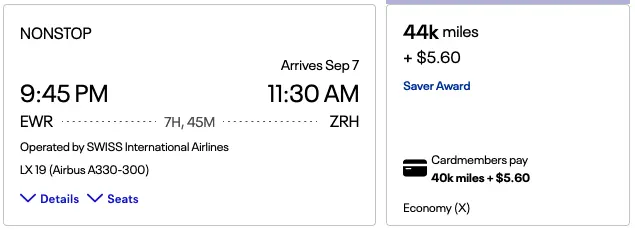
United MileagePlus: 44,000 miles + USD $5.60 in taxes and fees
Air Canada Aeroplan: 35,000 miles + CA$79 (approximately USD $58) in taxes and fees
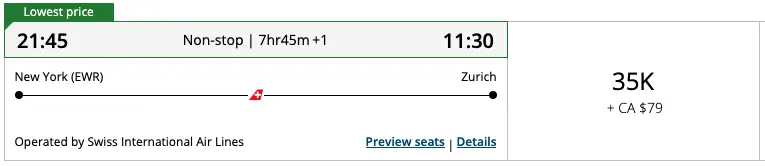
Without any bonus in play, the two options pull in different directions. Aeroplan asks for fewer miles (35,000 versus 44,000) but charges noticeably higher fees. United asks for more miles but keeps fees close to zero.
If your priority is spending fewer dollars in fees, United is the straightforward choice: transfer 44,000 Chase points to United at 1:1 and book the flight.
How the 20% Aeroplan bonus changes the math
In April 2026, Chase ran a limited-time 20% transfer bonus to Air Canada Aeroplan. During that window, every 1,000 Chase points transferred became 1,200 Aeroplan miles.

The flight still costs 35,000 Aeroplan miles. But with the 20% bonus, the number of Chase points you actually need to cover that changes:
35,000 miles ÷ 1.20 = 29,167 Chase points required
Chase processes transfers in 1,000-point increments, so you round up and transfer 30,000 Chase points. Those 30,000 points deposit 36,000 Aeroplan miles — 1,000 more than needed to book.
Compare that to the United option: 44,000 Chase points, with no bonus available.
Booking the Aeroplan route during the bonus window costs 30,000 Chase points instead of 44,000. That is 14,000 fewer flexible points spent on the same flight. You do pay higher fees with Aeroplan — roughly $58 versus $6 — so you are trading some cash for a meaningful reduction in your points balance. Whether that trade makes sense depends on how you value your remaining Chase points, but the numbers are concrete.
The advantage grows when booking for multiple passengers. For two travelers, the Aeroplan route requires 70,000 miles. With the 20% bonus, that translates to 58,334 Chase points, which rounds up to 59,000. The United route would require 88,000 Chase points for two seats. The gap widens to 29,000 points saved — for the identical flights on the same aircraft.

The most important rule: have a redemption confirmed before you transfer
This point deserves its own section because it is where the most preventable mistakes happen.
Points held in a bank program — Chase, Amex, Capital One, Citi, Bilt — are flexible. You can send them to any of dozens of partners. Once you transfer them to a specific airline or hotel program, that flexibility is gone. Aeroplan miles stay in Aeroplan. United miles stay in United. In almost all cases, there is no way to reverse a transfer.
The practical consequence: a transfer bonus is only valuable if you have already confirmed the award is available before moving the points. Points are flexible; miles are not. A Chase point can become a United mile, an Aeroplan mile, a Hyatt point, or a Flying Blue mile. Once it becomes any of those things, it can only be used within that program.
The right sequence for acting on a bonus looks like this:
1. Identify the trip you want to book 2. Search for availability and confirm the award seat or hotel night is bookable at the price you expect 3. Have your travel dates and passenger details ready 4. Transfer the points 5. Book immediately after the transfer posts — usually within a few minutes
The most common mistake is seeing a bonus headline and transferring speculatively — moving points to a program with the intention of booking later, only to find availability has disappeared, pricing has changed, or a program has shifted its award chart in the time between the transfer and the search. Once the points leave your bank account, there is nothing to recover.
How to evaluate whether a bonus is actually worth using
A high bonus percentage is not sufficient reason to act. Work through three questions before transferring:
1. Do you have a specific redemption identified and confirmed as available? If the answer is no, stop. The bonus percentage is irrelevant without a destination and confirmed availability.
2. Does the bonus change which option gives you the best value? Run the math on your actual itinerary, using the current bonus. In the example above: 35,000 Aeroplan miles needed, divided by 1.20 bonus, equals 29,167 Chase points required — rounded to 30,000 — compared to 44,000 for United. The bonus made a previously secondary option meaningfully more efficient.
3. What does depleting this balance cost you? If you are close to having enough points for another redemption you care about — a different trip, a hotel stay, a spending threshold — transferring now may interrupt that plan. Points in a bank account carry optionality. Once moved, that optionality is spent.
When a transfer bonus is not worth taking
A transfer bonus can create a false sense of urgency. A 40% bonus on a poor redemption is still a poor redemption. If the destination program has weak award rates for the routes you fly, more miles in that program does not help you.
Some programs run high bonuses specifically because they struggle to attract transfers on their own. The bonus is the marketing incentive. Before acting, compare the mileage cost for your intended route through the bonus program against what the same route costs through a program you already trust. If the comparison does not favor the bonus program even with the extra miles, the offer is not for you.
It is also worth noting that depleting a points balance purely for the bonus — without a redemption ready — often leads to miles sitting idle in a partner account for months or years, subject to whatever changes the program makes in the meantime. Loyalty programs have devalued their awards frequently over the past decade. Miles that sit unused absorb that risk.
How long do bonuses last, and how to track them
Most transfer bonuses run between two and six weeks. The April 2026 Chase–Aeroplan bonus, shown at the top of this post, ran through April 30. You can see current promotions directly on your bank's transfer page when you log in: Chase, Amex, Capital One, Citi, and Bilt all display active bonuses on the partner selection screen.
Several independent points-and-miles publications track new bonuses within a day or two of launch: The Points Guy, View from the Wing, and One Mile at a Time are the most consistent. Setting a Google Alert for your preferred bank and partner program names takes a few minutes and can surface promotions you would otherwise miss.
Historical context: what bonuses have looked like
Transfer bonuses appear with some regularity, even though the exact programs and percentages shift. As a reference for what normal looks like: Chase has run 25–40% bonuses to Virgin Atlantic Flying Club multiple times over several years; Amex has offered 30% bonuses to Avianca LifeMiles on more than one occasion; Capital One periodically runs 20–30% bonuses to selected partners. These are not rare one-time events.
That history is relevant to planning. If a program has offered a transfer bonus before, it may well offer one again. If you know you want to redeem Aeroplan miles for a flight several months from now and no bonus is currently running, it may be worth waiting briefly to see whether one materializes before transferring. The risk is that award availability closes in the meantime — which, again, brings everything back to the cardinal rule: confirm availability first, then transfer.
Bottom line
Transfer bonuses reward travelers who already have a specific redemption ready. The same Chase points that would normally cover 44,000 United miles can, during a 20% Aeroplan bonus, cover a 35,000-mile booking with just 30,000 points — provided you confirm availability before transferring. Find the award first, run the math with the current bonus applied, and transfer only when both conditions are met.